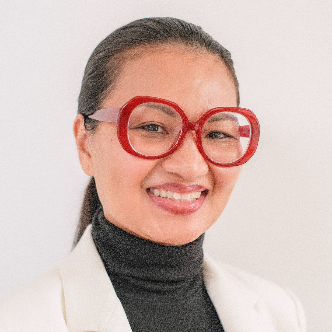
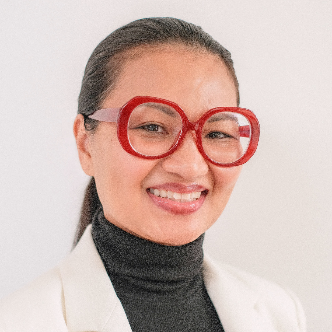
Kinara S. Yang is a Cham–Khmer American, community organizer, and humanitarian whose life’s work is rooted in service and resilience. She has joined medical missions to underserved provinces in Cambodia through the Cambodian Health Professionals Association of America (CHPAA) and now serves as a Clinical Advisor with the Division of Allergy, Immunology, and Transplantation (DAIT) at the National Institutes of Health, supporting research that brings hope and healing to patients worldwide.
Born during her family’s long journey on foot to a refugee camp in Nong Samet, Thailand, after the fall of the Khmer Rouge regime, Kinara came to the United States in 1981. She grew up in Lowell, Massachusetts, in a close-knit immigrant and refugee community, and as the eldest of six children, learned early the values of responsibility and care. Now living in Brooklyn, New York, with her partner, Kinara carries her heritage, her story, and her deep belief in the power of community into every aspect of her work and life.
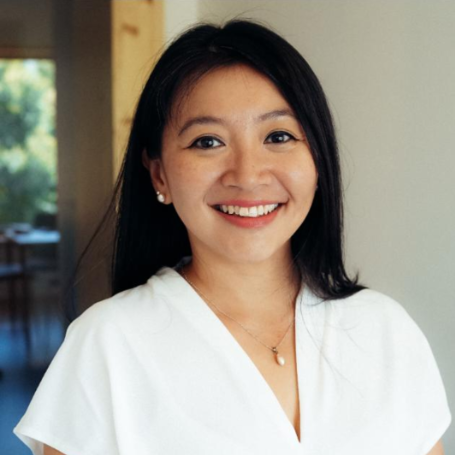
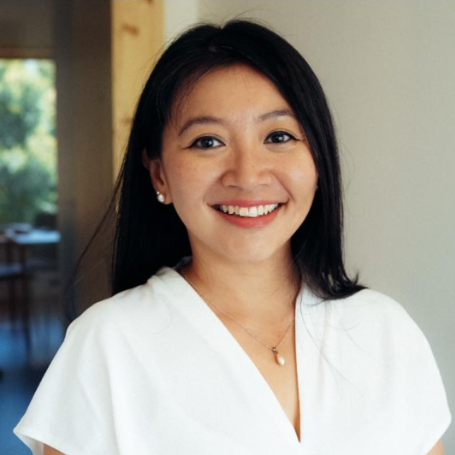
Ling Ling a former engineer, is presently a PhD candidate at Iscte–University Institute of Lisbon. Her PhD research focuses on the psychological and sociocultural adaptation of refugees in transit and resettled countries. The aim of the research is to develop a measure to inform researchers and practitioners in their refugee integration interventions and policies.
She holds two master’s degrees in psychology - one in Intercultural Relations from Iscte–IUL, Portugal, and another from the University of Hertfordshire, UK - as well as a bachelor’s degree in Electronics Engineering from Multimedia University, Malaysia. Before pursuing her academic path, Ling Ling built an international career of over a decade in learning and development, leading global initiatives across technology, travel, and humanitarian sectors in 16 countries on four continents.
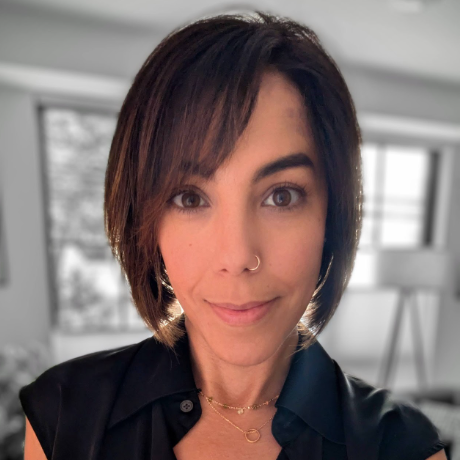
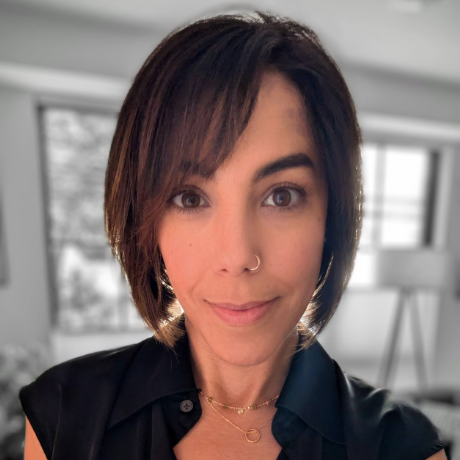
Sanaz is a psychotherapist, community organizer, and trauma-informed yoga instructor primarily working with immigrants and refugees. An Iranian-American, guided by a deep belief in collective healing, cultural humility, and committed to the restoration of dignity for those impacted by systemic oppression and displacement. Based in Philadelphia, Sanaz works with immigrants and refugees, as well as many students/faculty at UPenn. Her group work with refugees began in 2019 at a refugee camp in Greece, and has since extended into local community spaces. Fluent in Farsi, she has facilitated trauma-informed yoga support groups for Afghan women refugees - blending movement, psychoeducation and group support.
Sanaz is also a co-founder of a nonprofit in Philadelphia that centered the Woman, Life, Freedom movement - through diaspora mobilization, cultural events, and community building. She currently serves on the board of two nonprofit organizations focused on refugee community building and native-language mental health care, contributing to spaces that foster empowerment and the reclamation of agency.
Jennifer Young, PsyD, has over a decade of experience working in the nonprofit and public service sectors. She is presently in private practice where she primarily works with Humanitarian Aid Workers, Third Culture Kids, expatriates, public servants, and Returned Peace Corps Volunteers. She is also the founder of a startup nonprofit project called Kin-nection, whose mission is to increase access to remote mental health and language professionals to serve displaced people.
Jacinda Lee, ALMFT, is a Clinical Psychology PhD candidate at Rosalind Franklin University of Medicine and Science and is currently completing her predoctoral internship at the Palo Alto Veterans Affairs Healthcare System. She is also an Associate Licensed Marriage and Family Therapist. Jacinda’s clinical interests focus on integrating family systems approaches within a biopsychosocial framework to support medically complex and culturally diverse populations.
 Google
 Outlook.com
 Yahoo
Yahoo